IV administration set: parts, types and how to use it correctly
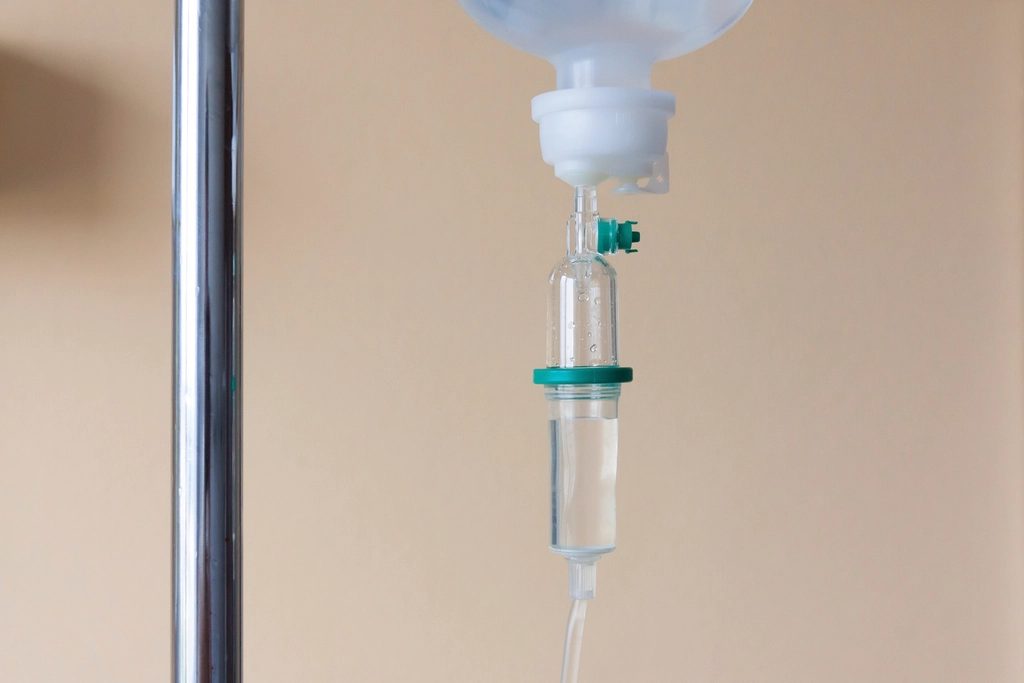
The IV administration set is the device that connects a bag or bottle of solution to the patient’s catheter and makes it possible to control the rate at which the fluid flows in. It looks like a simple supply, but choosing the right one and using it properly has a direct impact on the safety of intravenous therapy.
Parts of an IV administration set
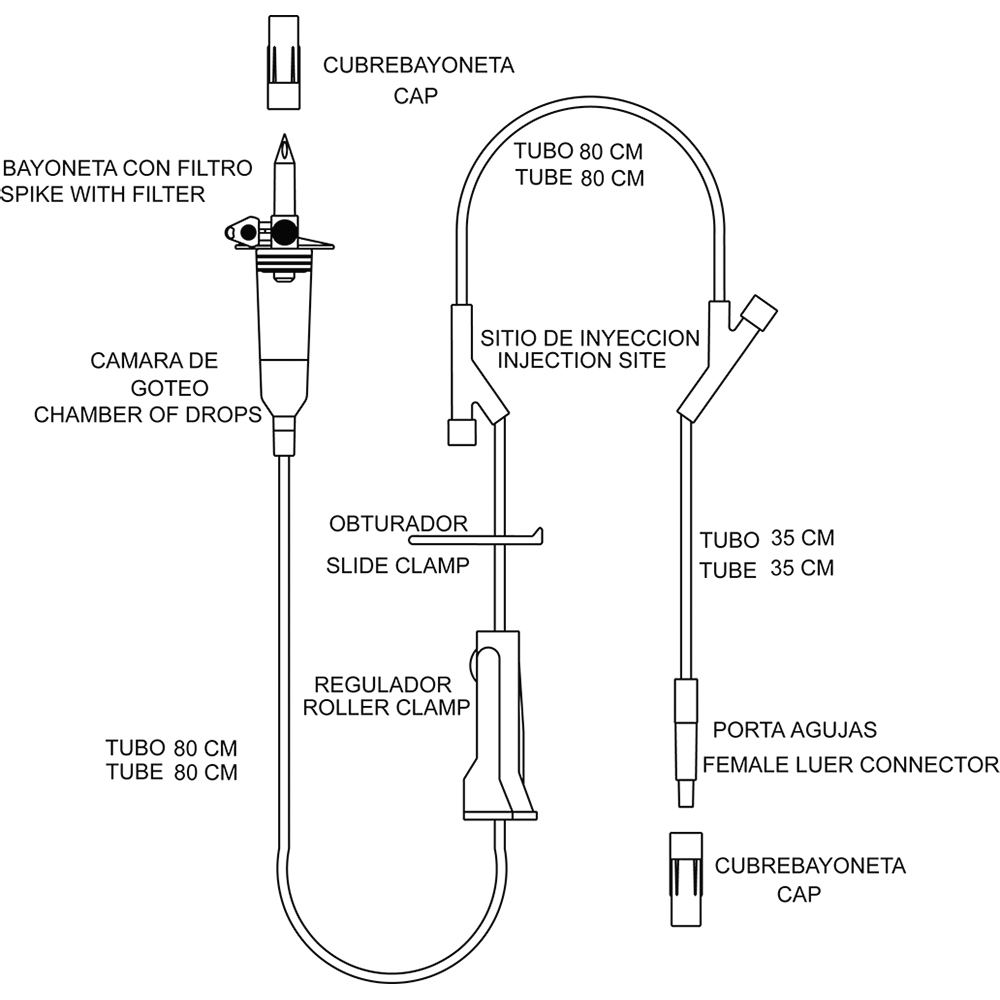
- Spike: it is inserted into the port of the bag or bottle.
- Drip chamber: it lets you see and count the drops; it is filled to about halfway.
- Flow regulator: usually a roller clamp that squeezes the tubing to adjust the drip rate.
- Tubing or line: it carries the solution to the patient.
- Injection port: it allows medicines to be given without disconnecting the line.
- Connector: it attaches to the catheter, ideally with a luer lock threaded connection.
Macrodrip and microdrip
The difference lies in the size of the drop. Macrodrip sets produce large drops and are used to administer larger volumes in adults. Microdrip sets produce small drops, which allows finer control, useful in pediatrics and when infusing low volumes or medicines that require precision. The number of drops equivalent to one milliliter is printed on the package, and it is the figure used to calculate the drip rate.
We carry the Flebotek Quirúrgico, a disposable needle-free IV set, and the Flebotek 0–100, designed for the administration of medium volumes. Both come in an individual sterile blister pack.
How to calculate the drip rate
To find out how many drops per minute should fall, multiply the volume to be infused in milliliters by the set’s drop factor and divide by the time in minutes. For example, to infuse 1,000 mL over 8 hours with a 20 drops/mL set: 1,000 × 20 ÷ 480 minutes gives about 42 drops per minute. The drip rate is checked periodically, because it changes with the position of the patient’s arm and the height of the bag. When the rate must be exact, as with high-alert medicines, an infusion pump is used, which requires its own compatible sets. In young children, microdrip or a pump is the rule, because an error of just a few milliliters has a greater impact.
Best practices with the IV administration set
- Check that the package is intact and that the set has not expired before opening it.
- Perform hand hygiene and use aseptic technique when connecting the bag and the catheter.
- Prime the entire line to remove air before connecting it to the patient.
- Label the set with the date and time it was put in place.
- Change the set according to the institution’s protocol: those used for blood or lipids are changed more often than those used for simple solutions.
- Disinfect the injection port before each use.
Other types of venous access
Patients who need chemotherapy or other prolonged intravenous treatments often have an implanted venous port under the skin. Special needles that do not damage the port’s membrane are used to access it, such as the Surecan 20G needle. Handling it requires trained staff and sterile technique.
Patient monitoring
During the infusion, the catheter site is checked frequently. Pain, redness, swelling, coolness of the skin or a drip that stops may indicate phlebitis or that the fluid is leaking out of the vein. In those cases the infusion is stopped and the venous access is evaluated.
All the medical devices we distribute have a health registration, which you can look up on the website of INVIMA, Colombia’s health products regulatory agency.
If your institution needs these products, add them to your list in our online store and request a quote: we will reply with availability and prices.